A standard baccarat hand takes roughly a minute to resolve. Speed baccarat compresses that same hand into fifteen to twenty seconds - no ceremonial pauses, no lingering shots of the shoe, just decisions and outcomes stacked back to back. For players who value tempo over theater, this format has quietly become one of the more demanding tables in the online casino, precisely because it removes the buffer time that slower games give you to think.
That compression changes more than pacing. It changes how bankroll drains, how patterns feel (even when they're statistically meaningless), and how quickly a bad session snowballs if you're not prepared. Many players jump into a fast-paced baccarat b game expecting the same rhythm as the classic version, only to find their chip stack moving at a pace they didn't budget for. If you've been curious about how operators package this format - for instance, the speed baccarat b game variant offered in many online lobbies - it helps to understand the mechanics before the first hand is even dealt. The house edge doesn't shift, but your exposure to it does.
What follows is a practical breakdown of how speed baccarat actually works, what separates it from the traditional table, and how to build a strategy that respects the accelerated clock instead of getting run over by it.
What Makes Speed Baccarat Different From Classic Baccarat
Speed baccarat online keeps every rule of traditional baccarat intact - the same third-card draw conditions, the same Banker, Player, and Tie bets, the same payout structure. What changes is the delivery. Dealers move through the shoe faster, betting windows shrink, and the between-hand chatter that pads a regular table disappears almost entirely.
Shorter Betting Windows
Most speed tables give players around ten to twelve seconds to place a bet, compared to the twenty-plus seconds common on standard tables. That window is enough for an experienced player to act on a plan, but it punishes hesitation. Indecision under a countdown timer is where new players lose the most value, not from bad bets but from rushed ones.
Fewer Hands Per Hour, Wait - More, Not Fewer
The math here matters. A classic baccarat table might deal 60 to 70 hands per hour. A speed baccarat table can push past 200. That's roughly three times the volume in the same sixty minutes, which means three times the exposure to the house edge in either direction - good runs compound faster, and so do bad ones.
Minimal Ceremony, Maximum Focus
Traditional baccarat, especially in live dealer formats, often includes commentary, card reveals with dramatic pacing, and social interaction between players. Speed tables strip that away. The dealer deals, the result posts, the next hand begins. This suits players who want pure decision-making without the theatrical wrapper, but it also removes natural pauses that might otherwise prompt a player to reassess their approach.
Core Rules and Mechanics of the Speed Format
Before adapting any strategy, it's worth confirming that the rules under the hood are unchanged from standard baccarat - because the speed only affects presentation, not payout logic.
Card Values and Hand Totals
Cards two through nine keep face value, tens and face cards count as zero, and aces count as one. Hands are scored on the rightmost digit of the total, meaning a hand of 7 and 8 (15) counts as 5. This is identical across every baccarat variant, speed or otherwise.
The Third Card Rule
Both Player and Banker hands follow fixed drawing rules based on their initial two-card total. Players don't control these draws - the software or dealer applies them automatically, based on tableau rules that have stayed consistent since baccarat's earliest casino adoption. Understanding this fixed logic matters more in speed baccarat, because you won't have time to second-guess an outcome once the timer runs out.
House Edge Across Bet Types
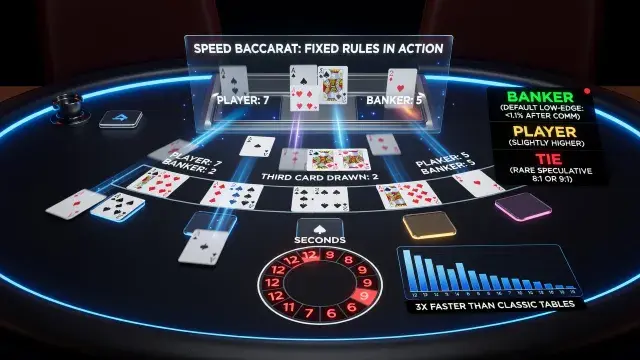
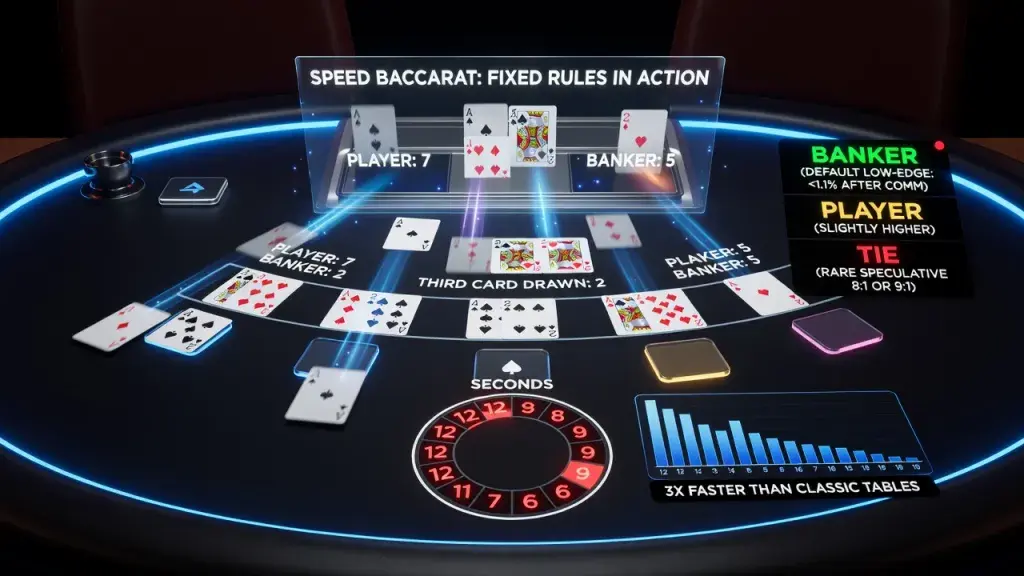
The Banker bet carries the lowest house edge, typically just under 1.1% after commission. The Player bet sits slightly higher, and the Tie bet - despite its tempting payout of 8:1 or 9:1 - carries a house edge well above 14%. These numbers don't change in the speed format. What changes is how quickly they accumulate against your bankroll if you're betting Tie repeatedly for the payout thrill.
- Banker bet: lowest long-term edge, standard 5% commission on wins
- Player bet: slightly higher edge, no commission
- Tie bet: highest edge, reserved for occasional speculative plays rather than a core strategy
Building a Baccarat Game Strategy for Faster Tables
A strategy built for a 70-hands-per-hour table doesn't automatically survive contact with a 200-hands-per-hour environment. The math is the same, but the psychological and bankroll demands are not.
Bankroll Pacing for High-Volume Play
If your usual session bankroll is designed to survive 60 hands, it needs to survive roughly three times that volume at a speed table. The simplest fix is to divide your bankroll by expected hands, not by expected time. A player who normally budgets $200 for an hour of standard baccarat should think in terms of $200 for 60-70 decisions - then scale accordingly when decisions triple.
Flat Betting Versus Progressive Systems
Progressive systems like Martingale or Fibonacci are already risky in standard baccarat; in a fast-paced baccarat b game, they become considerably more volatile. A losing streak that might unfold over fifteen minutes at a normal table can happen in five minutes at speed. Flat betting - wagering the same amount regardless of previous results - is generally more sustainable here, since it doesn't force escalating bet sizes into a compressed loss window.
Choosing a Primary Bet and Sticking to It
Speed tables punish indecision more than any other format. Committing to Banker as a default bet, and reserving Player or Tie for deliberate, occasional deviations, removes the cognitive load of re-deciding every ten seconds. Consistency isn't superstition here - it's a practical response to a shrinking decision window.
Speed Play Tactics: Reading the Table Without Slowing Down
Baccarat speed play rewards players who can process information quickly without falling into the trap of pattern-chasing, a common pitfall when hands arrive in rapid succession.
Ignoring the Scoreboard Trap
Most speed baccarat interfaces display a running history of Banker/Player results, often in a grid format. This history has zero predictive value - each hand is independent - but the visual pattern is seductive, especially at speed, where three or four Banker wins in a row can feel like momentum. Recognizing this as noise, not signal, is one of the more important mental disciplines in this format.
Setting Hard Stop-Loss and Stop-Win Limits
Because speed baccarat online moves through bankroll three times faster, a stop-loss limit needs to be set and respected before the session starts, not decided mid-session when emotions are already engaged. The same applies to stop-win limits - walking away after a defined profit target prevents a fast table from giving back gains just as quickly as it delivered them.
Using Auto-Play Features Deliberately
Many speed tables offer auto-play or auto-bet options that repeat a chosen wager across multiple hands. Used deliberately, this can enforce discipline by removing impulsive bet-switching. Used carelessly, it can also accelerate losses if the wager size wasn't calibrated correctly beforehand. Auto-play is a tool for consistency, not a substitute for a pre-set limit.
Common Mistakes Players Make in the B Game Format
The compressed pace of speed tables surfaces certain errors more clearly than a standard game would, simply because there's less time to correct course mid-session.
Chasing Losses Under Time Pressure
The countdown timer creates a subtle push toward reactive betting - doubling down after a loss simply because there's no time to think it through calmly. This is where progressive betting systems tend to unravel fastest in a speed environment.
Overvaluing the Tie Bet
The Tie bet's high payout is tempting precisely because speed tables generate more opportunities to try it. But its edge doesn't improve with volume - betting Tie more often simply means feeding a weaker bet more frequently.
Underestimating Session Length
Because each hand resolves so quickly, players often lose track of how long they've actually been at the table. Thirty minutes at a speed table can involve as many decisions as ninety minutes at a standard one, which means fatigue and impaired judgment can set in earlier than expected.
Pro Tips to Win Faster Without Losing Control
Winning "faster" in speed baccarat isn't about beating the house edge - that stays fixed regardless of pace. It's about extracting value efficiently while protecting the bankroll from the format's higher hand volume.
Favor Banker Consistently
Given its lower house edge after commission, defaulting to Banker across most hands remains the mathematically soundest baseline, especially when decisions need to be made quickly and repeatedly.
Track Session Time, Not Just Session Balance
Set a time limit alongside a bankroll limit. Because speed baccarat moves so much faster, a fixed number of minutes (say, 20 or 30) acts as a natural circuit breaker independent of whether you're up or down.
Practice on Low-Stakes Tables First
Before committing meaningful bankroll to a fast-paced baccarat b game, spend time on low-minimum tables to calibrate your reaction speed to the shortened betting window. This costs little and prevents the expensive mistake of learning the pace with real stakes on the line.
Frequently Asked Questions
Is speed baccarat rigged to favor the house more than regular baccarat?
No. The house edge percentages are identical to standard baccarat - the format only changes pacing, not payout structure or card-drawing rules. The perception of a heavier house edge usually comes from playing more hands per hour, which naturally increases total exposure over a session.
How much bankroll do I need for a typical speed baccarat session?
Calculate based on hands, not minutes. If you'd normally budget for 60-70 hands at a standard table, expect to need two to three times that amount for the same session length at a speed table, since hand volume roughly triples.
Can betting systems like Martingale still work in speed baccarat?
They carry more risk in this format because losing streaks compress into shorter real-world time frames, making bankroll depletion happen faster. Flat betting tends to be more sustainable for players who want to avoid rapid, uncontrolled escalation.
Why do speed tables feel more stressful even when I'm winning?
The shortened betting window and rapid hand resolution reduce natural downtime, which most players use to reset emotionally between decisions. Without that pause, both wins and losses feel more intense, even though the underlying odds haven't changed.
Should beginners avoid speed baccarat entirely?
Not necessarily, but beginners benefit from learning standard baccarat's rules and betting rhythm first. Once the third-card rules and bet types feel automatic, the faster pace becomes far more manageable.
Does the Tie bet ever make sense in a fast-paced format?
It can serve as an occasional, deliberate speculative bet with a small portion of bankroll, but it shouldn't form the core of any repeated strategy. Its house edge is substantially higher than Banker or Player, and higher hand volume simply means more frequent exposure to that disadvantage.